3 Hours in Mitte: History, Coffee & Hidden Courtyards
3 Hours in Mitte: History, Coffee & Hidden Courtyards Berlin's Mitte district packs an absurd amount of history into a few walkable blocks. You've got Cold W…
3 Hours in Mitte: History, Coffee & Hidden Courtyards
Berlin's Mitte district packs an absurd amount of history into a few walkable blocks. You've got Cold War landmarks, 19th-century museums, tucked-away courtyards, and some of the best coffee in the city. If you've got a free afternoon and want to make the most of it, this 3 hour itinerary berlin route covers the highlights without rushing you through them.
The walk covers roughly two kilometers from Alexanderplatz to Gendarmenmarkt, with plenty of stops for coffee, photos, and a quick bite. It's designed for someone who wants a mix of big-name sights and quieter corners that most visitors walk right past. For a broader look at short routes across the city, check out our 3 hour itinerary berlin guide with five different micro-itineraries.
Starting Point: Alexanderplatz to Hackescher Markt
What to See at Alexanderplatz
Alexanderplatz is the natural starting point for a Mitte walking tour. The square has been a public gathering place since the 17th century, and today it's a busy transit hub surrounded by shops and TV towers. The most recognizable landmark is the Berlin TV Tower (Fernsehturm), standing 368 meters tall. You don't need to go up it for this itinerary, but it's a useful navigation point throughout your walk.
The World Time Clock (Weltzeituhr) on the square's western edge is worth a minute of your time. Installed in 1969, it shows the time in 148 cities around the world and rotates slowly above a mosaic of Earth's continents. It's a small, quirky piece of East Berlin design that most people photograph and move on from.
Walking Toward Hackescher Markt
From Alexanderplatz, head east along the S-Bahn viaduct toward Hackescher Markt. The walk takes about ten minutes if you don't stop, but the arcades underneath the railway arches are full of small shops and cafes that might pull you in. These arches were once storage spaces for the railway and now house everything from bookstores to juice bars.
Hackescher Markt itself is a small square dominated by the S-Bahn station and a cluster of restaurants with outdoor seating. It's a good place to orient yourself before heading into the courtyards just to the north.
A Quick Detour: Marienkirche
If you have five extra minutes, step into St. Mary's Church (Marienkirche) just off Alexanderplatz. It's one of Berlin's oldest churches, dating to the 13th century, and the interior has a striking Dance of Death fresco from the 15th century. The contrast between the medieval interior and the modern square outside is jarring in a good way.
Coffee and Courtyards: The Hackesche Höfe Area
The Hackesche Höfe Courtyards
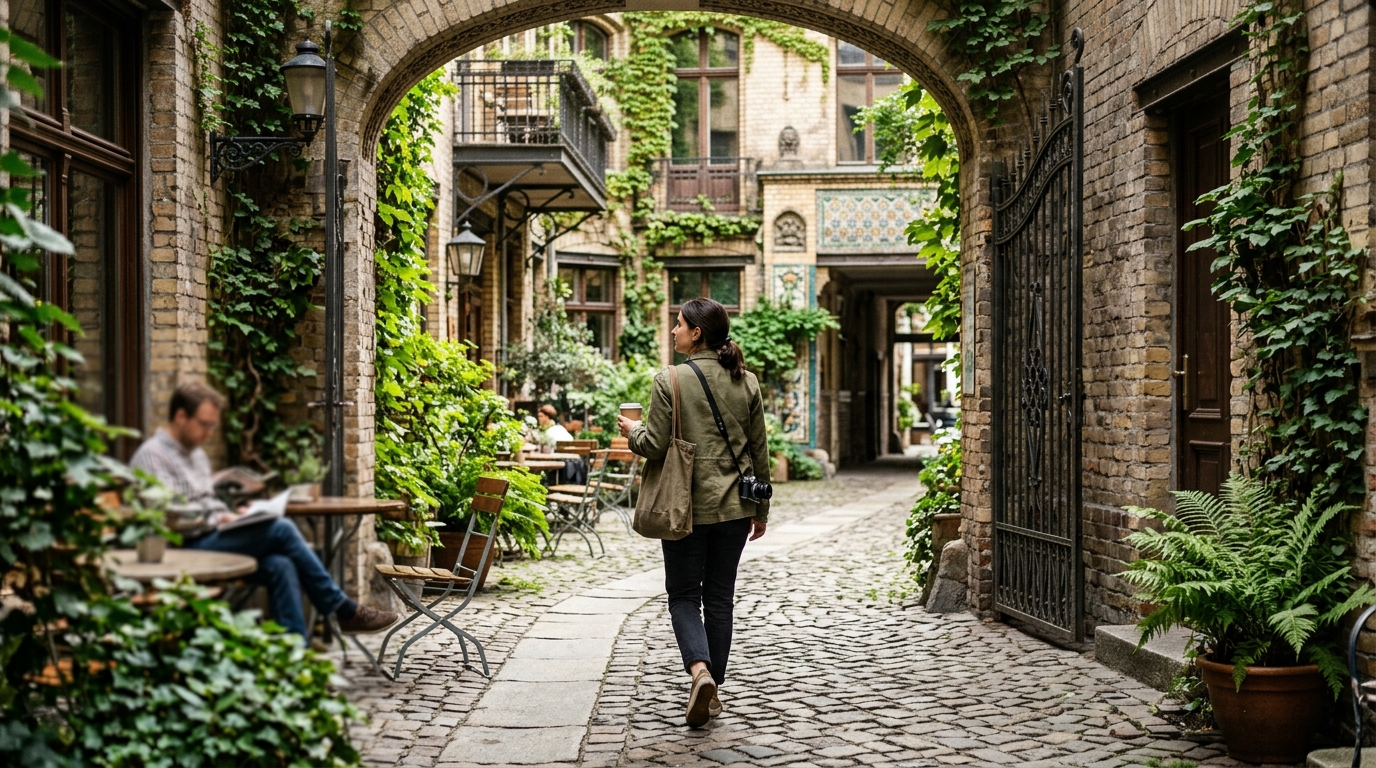
The Hackesche Höfe are a series of eight interconnected courtyards built in the early 1900s. They survived World War II with relatively little damage and were restored in the 1990s. Each courtyard has its own character, from residential entrances to retail spaces with small boutiques and galleries.
The first courtyard (Hof 1) is the most photographed, with its green and yellow Art Nouveau facade by architect August Endell. Walk through all eight if you have time, but even three or four will give you a sense of how Berliners lived before the war. The courtyards are free to enter and open during daylight hours.
Where to Grab Coffee
There are several good coffee spots in and around the courtyards. Bonanza Coffee Heroes on Oderberger Strasse is a short walk north and serves some of the best third-wave coffee in Berlin. If you prefer something closer, there are cafes inside the Höfe themselves where you can sit outside and watch people pass through.
For a quicker stop, the area around Hackescher Markt has several bakeries where you can grab a pastry and a coffee to go. Expect to pay around 4 to 6 euros for a flat white and a croissant.
Rosenthaler Strasse and the Memorial
A few blocks west of the Hackesche Höfe, you'll find the Memorial to the Murdered Jews of Europe, also known as the Holocaust Memorial. It's a field of 2,711 concrete stelae designed by Peter Eisenman, completed in 2005. Walking through the grid of varying-height blocks creates a disorienting, reflective experience that's hard to describe until you've done it.
The underground information center beneath the memorial is free to enter and provides historical context. If you're tight on time, even ten minutes walking through the stelae field above is worth it. This is one of those stops that puts the rest of your Berlin visit into perspective.
Museum Island in Miniature
The Bode Museum Bridge
From the memorial, head east toward Museum Island (Museumsinsel), a UNESCO World Heritage Site since 1999. The island holds five major museums, and you obviously can't visit them all in three hours. But you can walk the perimeter and appreciate the architecture without buying a single ticket.
Start at the Bode Museum at the island's northern tip. The building sits on a triangular plot and is reflected in the Spree River, making it one of the most photogenic spots in Berlin. The bridge leading to it is a good place to pause and take in the view.
The Berlin Cathedral
The Berlin Cathedral (Berliner Dom) sits at the island's southern end and is impossible to miss with its massive green dome. Completed in 1905, it was heavily damaged during the war and rebuilt in a simplified form by 1993. You can go inside for a fee, but for this itinerary, the exterior and the surrounding Lustgarten park are enough.
The Lustgarten in front of the cathedral is a flat, grassy square that has hosted everything from military parades to political rallies to public concerts. Today it's a pleasant spot to sit for a minute and watch tour groups cycle through.
A Note on the Pergamon Museum
The Pergamon Museum is Museum Island's most famous attraction, but it's currently undergoing a multi-year renovation with parts closed to the public. The Pergamon Altar, its centerpiece, is not expected to reopen until 2027. If you're planning a future trip with more time, check the official Staatliche Museen zu Berlin website for current opening status.
A Quick Bite and Final Views
Gendarmenmarkt
Finish your walk at Gendarmenmarkt, about ten minutes south of Museum Island. It's widely considered Berlin's most beautiful square, flanked by the German Cathedral, the French Cathedral, and the Konzerthaus in the middle. The symmetry and scale make it feel grand without being overwhelming.
There are cafes and restaurants on the square's edges where you can sit outside and rest your feet. The French Cathedral has an observation platform you can climb for a small fee if you want a bird's-eye view of the area.
Where to Eat
If you're ready for a proper meal, the area around Gendarmenmarkt has plenty of options. For something quick and distinctly Berlin, look for a currywurst stand or a döner kebab shop within a few blocks. For a sit-down meal, the restaurants on Charlottenstrasse offer German and international options at mid-range prices.
If you prefer to keep moving, grab a snack and head to the Spree River nearby. There are walkways along the water where you can sit and watch boats pass under the bridges.
Wrapping Up the Route
By the time you reach Gendarmenmarkt, you'll have covered Alexanderplatz, the Hackesche Höfe, the Holocaust Memorial, Museum Island, and one of Berlin's prettiest squares. That's a solid three hours of walking, stopping, and absorbing the city without feeling like you've checked boxes on a list.
If you enjoyed this route through Mitte, you might also like our 3 hour Kreuzberg food and canal walk guide to Kreuzberg, which covers a completely different side of Berlin with food stalls, canal paths, and street art.
FAQ
How long does this Mitte walking tour take?
The route is designed for three hours at a comfortable pace, including stops for coffee and photos. If you linger at the Holocaust Memorial or add a museum visit, plan for closer to four hours. You can also shorten it by skipping the memorial detour and going straight from the Hackesche Höfe to Museum Island.
Is this itinerary doable in bad weather?
Most of the walk is outdoors, so heavy rain will make it less enjoyable. The Hackesche Höfe courtyards have some covered areas, and there are cafes and shops where you can wait out a shower. In winter, the route is still walkable but dress warmly, as Berlin temperatures often hover around freezing from December through February.
Do I need to book anything in advance?
No. This itinerary is built around public spaces, courtyards, and exteriors that don't require tickets. If you decide to enter the Berlin Cathedral or the French Cathedral observation platform, you can buy tickets on site. The museums on Museum Island do require tickets, but this route doesn't include museum interiors.
Conclusion
Three hours in Mitte gives you a concentrated dose of Berlin's layered history, from medieval churches to Cold War landmarks to restored courtyards. The route is walkable, free of mandatory tickets, and flexible enough to adapt to your pace. You can stretch it with a museum stop or trim it by skipping a detour. Either way, you'll leave with a real sense of why Mitte is the neighborhood most visitors think of when they picture Berlin.
The best part of a short itinerary is that it leaves you wanting more. Berlin rewards repeat visits, and each district has its own personality. If this walk sparked your curiosity, there's plenty more to explore across the city.

Put this to use with Placetory
Open Placetory and let it turn your next free afternoon into a Berlin route just like this one.
Download the app